

If you’re new to the dreadlock tribe, welcome! 🙂
Getting dreads will change you— and I’m not just talking about your external look.
Those who have never had dreads think that the process is much like getting a haircut. A little crocheting or styling and you can have perfect dreads in an instant. [LOL, I wish!!]
Adapting to this new hairstyle, especially during the beginning stages of locs, requires an unbelievable amount of time and patience. But there is a light at the end of the tunnel, and the good news is that it’s worth it!
How to Stay Patient During the Early Stages of Dreads
When you feel like your starter locs are too crazy to handle, regain patience by remembering these tips:
1. Don’t expect them to look amazing at first.
Trust me, they won’t. Real talk here- during the first three to twelve months (or more) of this hair journey, you can expect them to look loopy, frizzy, messy, and wild. It is what it is.
I documented my own loc journey here, and you’ll see how wild they looked during the ugly stage. The good thing is that it’s only a phase of the locking process and they didn’t stay that way forever.
2. Don’t listen to the negative talk coming from your friends and family members.
I’ve been told many times that my loose natural hair looked better before I had dreads. And I’ve heard people within the dreadlock community experiencing the same thing within their social circles, so I know I’m not an isolated case.
I appreciate it when people tell it like it is, but the problem is that when you start caring more about other people’s opinions when it comes to basic things like hairstyle choices, you eventually stop listening to your inner voice.
Let people say what they want, but stay true to yourself.
3. Don’t stress and learn to love the mess.
There will be many good days and perhaps many bad days, but smile regardless. I promise it’ll get better.
Healthy locs go through many changes in their first year or two (depending on the texture of your hair). We will all have different timelines due to our hair type, the different types of locs methods used, and the condition of your hair.
Also, when you Google the different stages of locs, you’ll find a bunch of answers because they’re defined differently by different people. But in essence, the various stages of loc evolution go like this:
– The baby stage (or starter stage) is the time during the very beginning of your locs journey. With baby locs you’ll probably question if they’re even knotting.
Even if you have instant locs, they might look like they’re coming apart and you may have a lot of loose hair. But do not worry, this is just part of the process.
Palm rolling them won’t make a huge difference but it will encourage their round shape and the hairs to start matting.
– Teenage locs are a bit rebellious (hence the name… they’re in their “teenage stage”, get it?)
During this time, they’ll kind of have a mind of their own. Just remember to keep them clean (don’t skip wash days), moisturize them as needed, and separate your roots regularly.
The budding phase is when your locs actually start to look like matted hair (finally!) but shrinkage also happens.
For some, this will still be considered the ugly phase because the locs are not as uniform. Depending on your personal preferences, you can maintain them every 6 to 8 weeks to make them look neater (or more professional for work) and tame the new hair growth.
Don’t overdo it with your re-twisting routine, especially when it comes to the new growth, because it’ll put too much stress on your scalp which can lead to traction alopecia, aka hair loss.
If you’re anything like me, this stage will last well past your first year of locs.
The adult stage is the final stage of your loc journey and is also the loc stage that will last the longest if you keep your locs for more than 3 years. At this point, you’ve obtained mature locs.
This is the most rewarding phase, and once you look back at all the progress your dreadlocks have made, you’ll realize that the whole locing process was worth it.
4. Wrap your locs loosely.
Wear a hat, satin scarf, headbands, head wraps, a silk-lined beanie, or anything that will cover up the roots.
Tight styling can be damaging to your locs long-term, so stick with loose styles and have fun with them.
There are different styles tutorials on YouTube where you can learn a bunch of different ways to style short and long locs. Get creative and find your new stylish normal.
For special events and occasions, you can go get your locs styled at a hair salon (or barber shop). Find a loctician who specializes in this first.
5. Wear beads and fun accessories.
One of the reasons dreadlocks are so much fun (in my opinion) is that you can add cool beads and accessories to them.
You can find tons of options and designs on Etsy and Amazon, as well as at dreadlock shops and Facebook dreadlock groups.
If you’re into crafty things, you can learn to make your own and possibly even sell them for profit.
The style of your locs can be one hundred percent personalized to match your personality!
6. Don’t look in the mirror often, or for a long time.
The less time you spend staring at your hair in the mirror, the less you’ll remember what your messy locs actually look like.
During the starter loc phase, the health of your hair is more important than its wild appearance.
7. Take monthly progress pictures, especially on the good days.
The change your locs are making will not be evident when you’re looking at your hair every day that is why creating a photo timeline will help.
Seeing the change not only reminds you of how far your locs have come, but it’s also a way to keep you encouraged on the days when you feel like you’re making no progress at all.
8. Join dreadlock community groups.
Facebook has several loc community pages where people post their progress pictures all the time.
Seeing the before and after transformations in other people will help you keep up your faith in your own locs.
While your hair may go through a different transformation process, it’s cool to see how it evolves in general.
Here’s my dreadlock journey in photos. For your encouragement, look at the first few months of my journey compared to years 5 and 6!
9. Don’t compare your dreads to others.
Remember that your hair texture and maintenance method may be different than the person whose dreads you idolize on social media.
While your dreads may not look identical to someone else’s in the future, in due time, they’ll look amazing!

10. Remind yourself of the reason why you got dreads in the first place and hold on to that goal.
If you want dreadlocks, you have to accept that it comes at the price of patience and patience is a virtue.
If you don’t want to wait, then consider faux locs (like butterfly locs) or other types of loc extensions. This will give you nearly perfect locs while the rest of your hair matures.
11. Do occasional maintenance but don’t overdo it.
The best thing you can do to ensure a healthy scalp, no product buildup, and strong hair for long dreads is to take care of your dreadlocks properly.
Keep your hair clean, moisturize your locs as needed, separate the roots weekly, palm roll on occasion, and let them be!
Locs change constantly. It’s exciting to watch them mature.
Also, don’t overwhelm your hair with oils and products. Here are some ways to incorporate natural ingredients in your loc care routine.
– To moisturize your dreads, use a water-based product. My moisturizer is super easy to make. Simply blend distilled water and essential oils in a spray bottle and apply as needed.
– To cleanse your scalp post-workout, add witch hazel to your moisturizer spray and apply it to your scalp.
– For a dry scalp, moisturize your scalp with water and then massage a tiny amount of a carrier oil (like jojoba oil, olive oil, or coconut oil) for 5 to 10 minutes. Leave it on your scalp overnight and wash off the following morning.
– For an itchy scalp, make a scalp elixir gel with fresh aloe vera juice from the leaf plus a few drops of tea tree oil and apply it to your scalp. In this post, I teach you exactly how to make it.
– For softening your locs, try a rose water spray (like this DIY one I make) or rinse your hair with diluted apple cider vinegar.
The best products for your locs come from nature, not manufactured with chemicals.
12. Accept what you cannot change, such as the discomfort of messy hair.
Society is going to tell you that you have to be happy and perky all the time, but the reality is that we were born with a variety of emotions for a reason.
Be real with yourself.
It’s okay to be annoyed with your locs. It’s okay to feel uncomfortable, weird, or whatever you’re feeling. But the key is to accept it and move forward.
Don’t get stuck in those negative feelings.
Also, remember that society is constantly trying to define what is beautiful. Embrace your natural beauty during this new journey.
13. Learn what is triggering your impatience and seek ways to improve yourself in those areas.
In my case specifically, it was my self-esteem issues.
I have had low self-esteem ever since I can remember, and getting dreads helped me overcome some of those feelings, including a negative self-image.
I’m still a work in progress, but having messy hair allowed me to care less about other people’s perceptions of me.
14. Take deep breaths.
Learn to let go of control of the mentality that your hair needs to look perfect all the time.
15. Practice mindfulness.
Be grateful for the progress you make each day. Move your focus away from any negative emotions or comments from others.
Pay attention to the present moment.
16. Find healthy distractions.
Pick a hand hobby, like knitting, crocheting, learning an instrument, painting, etc.
Perhaps in the time that it takes your locs to fully mature, you’ll discover a hidden talent within yourself too.
17. Remember that great things take a lot of time and dreadlocks are no exception.
Think about this:
- A healthy baby needs about 9 months to grow in the womb before it’s born. And it won’t be until after their first year that they’ll begin talking, walking, and becoming more independent.
- It takes a coffee plant about 5 years to grow before it will reach full fruit production.
- An apple tree will take about 10 years to produce fruit after the seed has been planted.
Take off some of the pressure you’re feeling and allow yourself to enjoy the journey, no matter which stage you’re at.
Do your locs need a natural pick-me-up? Check out these 39 DIY recipes to revitalize your dreads!
Download the 8 Dreadlock Moisturizer Spray Recipes!
Please fill out the form to receive the download in your inbox.
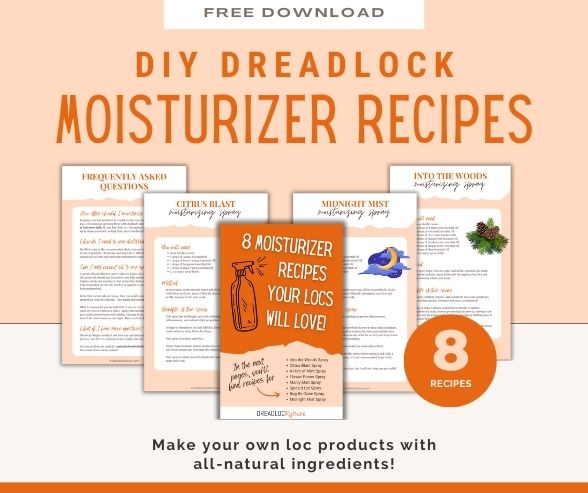
If there’s an error or the download doesn’t come through, send me a message at book@dreadlockulture.com and I will happily send it to you. 🙂
This article was originally published on August 10, 2020. It has since been updated and improved.


14 comments
I started my loc journey this July, I have a 4c type hair and started with comb coils. Recently my locs have started to puff up a bit, but the roots are fin. Any advice on how to fix that?
Hi Asher, your locs will adjust as they mature, so it’s normal for them to puff up. Which part are you wanting to fix? Do you want to make the roots puffier or the locs themselves thinner?
Just got partial dreads very excited for this process. Enjoying reading all the info here learning a lot and glad to find your blog
Thank you for your kind words 🙂
So exited for you and your journey!!
I felt like I wrote this down myself and just re read it back to me. Everything you said helped me ❤️💯
🙂 So happy to hear that!!
Hey Nadia!
I was wondering.
What is semi freeforming?
Does it mean that you don’t retwist that often?
I want to start semi freeform,
But a lot of people say that it’s important to retwist your new growth frequently so that your dreads get trained.
So I don’t understand how to start my semi freeforming journey.
Sorry for all the questions
I hope you have a great day!
Hi Daniela!
Yes, semi free-forming requires a lot less professional maintenance.
If you want to keep your locs neat at the root, I recommend retwisting once every 6 to 8 weeks. Retwisting more often than that can cause a lot of strain on your scalp and lead to hair loss/ traction alopecia later on.
I get retwists only once a year but I maintain the new growth by separating my locs at the root about once a week. If you don’t separate your roots often, it will get very messy (I learned this the hard way, lol). I have some loose strands at the root and I leave those alone. Some have turned into ultra-thin locs over time, and other strands are too stubborn to knot. 😉
Either way, your locs will adjust over time. The main difference will be that the root won’t look as “tidy” if you don’t retwist often.
I hope that was helpful! If you have any other questions, let me know- I’m always happy to help 🙂
Nadia, thank you for this post. Just today, I was feeling some kind of way…not a good way about how my locs look today. I’ve had my locs for 16 months. It’s been 3 weeks since my last retwist so I gave them a wash and now the roots are looser. I have some locs around the perimeter of my head that have barely started to bud so those have some unraveling. Overall not very appealing. Thanks for the reminder that it’s part of the journey. Your suggestions have shifted my thoughts from negative to acceptance. You also reminded me to get back to the crochet project I have in progress. Thank you!!!
You’re welcome Lorna! Trust me, I have my fair share of bad loc days…but lots of good ones too. That’s part of what makes the journey so special and unique to the loc’d community. What type of crochet project are you working on? Sounds fun! 🙂
I just started my journey I have 144 locs. I used two strand twist. I can’t wait until the frizzy stage I love that look honestly but. I already had so much shrinkage. It’s got me wondering when will they drop back down or are they going to get shorter?
Hi Dree-Michele,
Yay, I’m excited for you starting your loc journey!
Since you mentioned that you used two-strand twists, I’m going to guess that your hair type is coarse. (Please correct me if I’m wrong) 😉
If that’s the case, you have an advantage in that your locs should mature within 6 to 12 months. After they’ve matured, your locs should stop shrinking.
They might go through a period of time where it seems they don’t grow at all, and then you’ll start noticing them gaining length.
I recommend you take progress pictures to help encourage you along the way. Often times you won’t notice your progress unless you have old pictures to compare what they looked like before versus what they look like now. (For sure that’s what has helped me!)
144?! i have about 80 and im struggling i cant imagine the the retwist, thats amazing!
What I’ve done is cut all my hair off it’s Curly and I’ve gotten Dreds but they keep coming undone so I’ve had my Dreds since Nov and Yesterday I twisted them they were so thin I took Two and twisted into one now my Question is can I continue with the twist and continue my Dred journey and if I do that how will I retwist when it’s time do I have to take the twist down or can I continue with the twist method on top of the Dreds? Robin