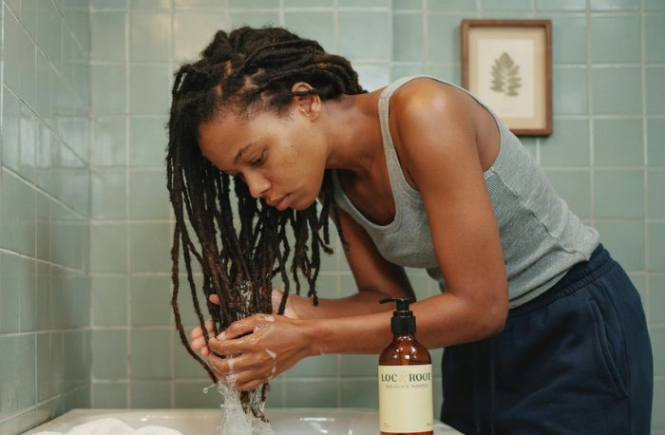
Have you ever wondered why your locs feel dry no matter how much you moisturize them? Or why do certain products seem to sit on your hair without doing anything?
The answer often comes down to your hair porosity.
Understanding porosity can completely transform how you care for your hair, choose your products, and retain moisture.
In this post, we’ll explore what hair porosity means, how to determine your hair’s porosity type, and what products and routines will work for your hair.
What Is Hair Porosity?
Let’s start with the basics—hair porosity refers to how well your hair absorbs and retains moisture.
Think of your hair shaft like a sponge. Depending on how open or closed the outer layer of your hair (the cuticle) is, moisture can easily flow in and out, or struggle to get in at all.
There are three main hair porosity types:
Low Porosity Hair
With tightly sealed cuticles, low hair porosity makes it hard for moisture to enter—but once it does, it’s locked in. This often leads to product buildup since oils and creams can sit on top of the hair.
What does low porosity hair feel like? It often feels smooth and resistant to moisture. Water beads up on the surface instead of soaking in.
Medium Hair Porosity
This is the “balanced” type. Moisture enters and stays at an ideal rate.
Medium porosity hair is generally easy to maintain and responds well to most treatments.
High Porosity Hair
Here, the cuticles are overly open, so while moisture enters easily, it also escapes quickly. This can lead to dryness, frizz, and brittle strands.
What type of hair is high porosity? Often, chemically treated or heat-damaged hair ends up here, but some people naturally have this porosity.
How to Determine Hair Porosity
Here are four easy methods you can try to check hair porosity at home.
1. Shower Absorption Test
This one’s super simple—pay attention during your next wash day.
- If water sits on top of your hair or runs off before soaking in, you probably have low porosity hair.
- If your hair absorbs water slowly but steadily, you’re in the medium porosity range.
- If your hair soaks up water almost instantly, it’s a sign of high porosity hair.
This method is a great way to observe your hair’s natural behavior without needing extra tools.
2. Drying Time Test
Ask yourself: How long does it take for my hair to dry after washing?
- If your hair takes a long time to dry, that’s often a sign of low porosity, because moisture enters slowly and stays longer.
- If your hair dries at a moderate pace, it likely has medium porosity.
- If your hair dries very quickly, it may be high porosity, since moisture escapes as fast as it enters.
Drying time is one of the easiest ways to determine porosity—no special tools needed, just a little observation.
3. Water Glass Method
This is the most well-known hair porosity test. Take a clean strand of dry, product-free hair and drop it in a glass of room-temperature water:
- If it floats, you likely have low porosity hair.
- If it sinks slowly, you’re somewhere in the medium hair porosity range.
- If it sinks quickly, you’re dealing with high porosity hair.
This test is sometimes called the hair porosity test water method and is great for quick insights.
4. Spray Bottle Test
Mist your dry hair with water:
- If the water beads up, your cuticles are sealed tight—low porosity.
- If it absorbs slowly, you have medium porosity.
- If it soaks in instantly, your hair is likely high porosity.
5. Strand Slide Test
Take a strand of hair and slide your fingers from the end to the root:
- A smooth texture suggests low porosity.
- A slightly bumpy feel indicates raised cuticles, common in high porosity hair.
Loc Care Tips Based on Porosity
Now that you’ve figured out your type, it’s time to customize your loc care routine. The right hair products for low porosity hair won’t work for high porosity hair, and vice versa.
Low Porosity Hair
If you have low porosity hair, your biggest challenge is getting moisture in. But once it’s in, it tends to stay put.
Best practices for low hair porosity hair care:
- Use lightweight, low-hair porosity oils.
- Try steam treatments or a heat cap to gently lift the cuticle.
- Use a clarifying shampoo for low porosity hair every 4–6 weeks to remove buildup.
- Apply products to damp (not soaking wet) hair for better absorption.
Product tips for low porosity hair:
- Look for water-based leave-ins and lightweight oils.
- Best oils for locs with low porosity hair:
- Apricot kernel oil
- Fractionated coconut oil
- Grapeseed oil
- Hazelnut oil
- Moringa oil
- Rosehip oil
Medium Porosity Hair
Lucky you! Medium porosity hair is the sweet spot, and most oils will work great for your hair.
Best practices:
- Avoid excessive product layering to prevent buildup.
- Use mid-weight oils like:
- Jojoba oil
- Argan oil
- Sweet almond oil
- Olive oil
- Hemp seed oil
- Pumpkin oil
High Porosity Hair
How do you fix porosity hair if it’s overly porous? Focus on sealing the cuticle and replenishing lost moisture.
Hair care for high porosity hair:
- Use heavier oils to seal in moisture.
- Do weekly deep conditioning treatments.
- Rinse with apple cider vinegar or rice water to help tighten the cuticle.
- Avoid heat tools and harsh chemical treatments.
Best products:
- Moisturizing and hydrating leave-ins that are water-based.
- Best hair oil for high porosity hair:
- Avocado oil
- Castor oil
- Coconut oil (regular)
- Flaxseed oil
- Evening primrose oil
- Neem oil
- Vitamin E oil (undiluted)
- Shea butter
Final Thoughts
Understanding your hair’s porosity allows you to stop guessing and start choosing products and routines that truly work.
Whether you’re seeking the right hair oil for low porosity hair, building a consistent hair care routine for high porosity hair, or simply trying to figure out what type of hair is high porosity, it all starts with awareness.
How to know hair porosity? Test it. Observe it. Learn from it.
The more you understand how your hair absorbs and holds moisture, the more control you’ll have over your hair health and your results. With the right knowledge, your locs can thrive—hydrated, defined, and well cared for.