

Aloe vera is an incredibly nourishing succulent. It is used in traditional medicine for healing wounds, treating burns, reducing inflammation, and as a digestive aid.
It’s also popular for treating skin conditions, such as acne, dermatitis,
One of the major problems we dreadheads face, especially with new dreadlocks, is an itchy scalp.
For the first year, my head would itch so badly that I would end up with bumps all over my scalp. I tried the commercial “itch relievers,” even one recommended by my loctician, but nothing significantly helped me.
When I started my dread journey, I realized that I could no longer use most of my favorite hair care products because they were not dreadlock-friendly.
The reason is that many of the traditional products we’re used to using on loose natural hair will actually attract dirt and lint, and create product buildup in dreads.
But thankfully, aloe vera is NOT one of those things.
In fact, your scalp will love it when you add this simple ingredient to your hair treatments.
The day I tried fresh aloe vera on my scalp, it felt like I had just hit a jackpot. This plant will work instant miracles on your itchy and inflamed scalp.
Aloe vera benefits for dreadlocks
There are so many incredible properties of aloe vera that I’m sure you’ll want to implement it into your hair care routine right away.
Note: When I speak of aloe vera, I’m talking about the pure aloe vera gel that you get straight out of the leaf, not the green stuff in a bottle. You’re welcome to use certified organic aloe vera, but it’s hard to come by in some places. Regardless, fresh is best!
If you haven’t yet figured this out, I’m all about natural ingredients! The only way to obtain everything this nourishing plant has to offer is by buying the real deal, ok?!
Continue reading to find step-by-step instructions on how I extract the gel and make my own aloe spray, so stay with me! 🙂
Aloe Vera’s Benefits
The benefits of aloe are well beyond what I’m listing here, but for the purpose of this blog, I’m only going to stick to the dreadlock-enhancing properties.
- It’s antiviral and antibacterial. Aloe vera contains anti-viral and anti-bacterial properties.
- It’s nourishing. It contains vitamins A, B1, B2, B3, B6, B12, C, and E,
and more than 20 minerals. According to the National Library of Medicine, “Aloe vera contains more than 75 different compounds, including vitamins (vitamin A, C, E, and B12), enzymes (i.e., amylase, catalase, and peroxidase), minerals (i.e., zinc, copper, selenium, and calcium)” and more.
- It’s cleansing. Aloe vera contains proteolytic enzymes that remove toxins and dead skin cells. Accumulation of sebum and dead skin cells on the scalp can cause seborrhea and partial baldness. Aloe helps prevent this.
- It’s hydrating. Aloe vera has a high water content. One of the main benefits of using aloe is to moisturize the scalp. Applying it directly to the roots of your hair will not just provide your skin with a lot of moisture, but also provide nutrition to your hair follicles. The best part is that once the gel dries, it won’t leave build-up behind or clog your pores.
- It’s residue-free!
- It strengthens the hair at the root. Aloe vera contains vitamins E, B12, and folic acid, which support, strengthen, and nourish your hair follicles. These vitamins create more elasticity in your hair, prevent breakage, and can prevent hair loss.
- It’s conditioning. Aloe is a natural conditioner that leaves you with smooth and shiny hair without causing it to dry stiff like the loc gels you buy elsewhere. This is the only “leave-in conditioner” you can ever use on your dreads.
- It improves scalp health. Aloe gel promotes hair growth, prevents itching on the scalp, reduces dandruff, and helps rejuvenate your hair.
- It tames excess frizz. Aloe vera helps to control frizzy hair. For those who like to have a controlled mane (especially at the beginning of the dread journey when flyaway hair is all too common), this is one of your best natural solutions. Applying aloe gel to the scalp can create a temporary firm hold for those loose hairs.
- It’s healing. Aloe vera will help to heal wounds caused by excessive scalp scratching. It might also help with scalp psoriasis and pimples on the scalp.
Important tips about aloe vera
Use the real leaf!
I’m gonna repeat what I said earlier. Don’t go to the store and buy any kind of aloe gel in a bottle. The bright green aloe vera you find at the pharmacy is fake. It’s full of additives and chemicals.
Where to buy it?
You can purchase aloe vera leaves at most grocery stores. You may have never seen it before because you weren’t looking for it, but it’s surprisingly a popular item.
Better yet, you can buy an aloe vera plant at a nursery and use the leaves as you need them.
Last resort, you can buy the leaves online (although that’s a pricier option).
Use aloe in moderation.
The pure form of aloe is extremely hydrating for your scalp, and a healthy scalp will render healthy locs.
A word of warning, though. In newer dreads, excessive use of aloe can soften the hair and hinder the locking process a bit. Like I mentioned earlier, aloe vera is a natural conditioner, and too much of it can cause detangling.
Spray it in those targeted itchy spots when necessary, but don’t drench your scalp with it. A little bit will go a long way.
Check out the recipe I use (below) which has many other properties to keep your scalp healthy and hydrated without the side effects of loosening your dreads at the root.
DIY Aloe vera spray for an itchy scalp
A while back, I researched online for aloe vera dreadlock recipes. I got amazing ideas from other people, and I used their tips to craft a recipe that is my current favorite.
You can alter this recipe to your liking.
This gel spray can be used on all hair types and styles. I use it on my dread roots, and my family uses it on their scalp too.
Everyone can enjoy the benefits this amazing succulent has to offer!
You will need:
- 1 aloe vera leaf
- distilled water
- 12 to 15 drops of essential oils (click here to choose your favorite blend)
- 5 drops of vitamin E oil (optional)
- A metal spoon
- A mini blender
- A thin metal mesh strainer
- A large bowl
- Two ice cube trays
- An 8 oz spray bottle

The method:
1. Thinly cut the pointy edges of the aloe plant so you’re not poking your fingers.

2. Cut the leaf into several sections and then slice it down the middle.
3. Using a spoon, scoop the gel out directly into the blender. Make sure you get all the gel out of the leaf. [Save the leaf for a nice facial treatment later!]


4. Blend the aloe gel until smooth.
5. Strain the gel through the strainer into a large bowl. You may have to swirl it around with a spoon to extract the maximum amount of gel.

6. Use an ice cube tray to collect all the aloe that has not passed through the strainer. I freeze these cubes and add them to my smoothies later.
You can do many other things with it, but don’t put it on your locs or scalp.

7. Pour 4 oz of aloe gel (from the bowl) into the spray bottle. For reference, my bottle holds roughly 2 cups of water, and I filled about half of it with gel.
8. Use the second ice cube tray to collect the rest of the aloe from the bowl and put the tray in your freezer. Since aloe vera is in its natural, preservative-free form, it can get rancid within two weeks, so freezing it is the best way to preserve it long-term.
9. To give it a nice scent, you can add essential oils to the spray bottle. My favorite essential oils for this recipe are rosemary, lavender, and tea tree oil.
A few drops will go a long way. I typically add 12-15 drops of essential oils to the entire 8-oz bottle. Since tea tree and lavender are very potent, I usually add 3 drops of each of those and 6 drops of rosemary.
If you only want to use one essential oil scent, then start by adding 5 drops of that oil to see how potent it is, and add more if you want the scent to be stronger.
10. While it’s not completely necessary, sometimes I add 5 drops of vitamin E oil to my spray.
Vitamin E helps to repair damaged hair follicles at the root and promotes hair growth. It also hydrates your scalp and increases blood circulation. Aloe vera naturally contains some vitamin E, but these drops give it an additional boost.
Caution: Not all vitamin E oils are created the same. Many contain additives, and some even contain soy. Make sure to read the label prior to purchasing.
10. Fill the rest of the spray bottle with distilled water. Shake and spray on your roots.

Save this aloe blend in the refrigerator to keep it fresh. Being that it has no preservatives, it can go rancid quickly if left out at room temperature. It also feels much more refreshing to your scalp when the spray is cold.
NOTE: When you’re ready for a new batch, pull one or two aloe cubes out of the freezer, and allow them to defrost at room temperature for an hour or two (or in the fridge if you’re defrosting it overnight). Then, go back to step # 9 and continue the process from there.
This spray should last up to 2 weeks in the fridge. It’s possible that the gel may turn a pinkish color; this is due to oxidation. If it smells weird, then it has spoiled.
I heard that adding a few drops of lemon juice may extend the shelf life. I’m not sure if this is true, but you can try it by adding a teaspoon of pure lemon juice (strain it first) to the spray.
Lemon juice can lighten your hair, especially when exposed to the sun, so keep that in mind.
Frequently asked questions
Where can I buy an aloe vera plant leaf?
There are three places where you’re likely to find aloe leaves.
– The produce aisle at the grocery store and health food stores (I’ve seen it usually near the fresh herbs section)
– At a nursery or succulent store (this is for buying an entire aloe plant)
What does aloe vera gel smell like?
Aloe vera has an earthy scent. I don’t find it to be very potent, but if you don’t like the smell, you can mask it with different fragrances based on the essential oil blend you use.
Can aloe vera gel help with dandruff or dry scalp issues in dreadlocks?
Yes, absolutely! Aloe vera’s hydrating and nourishing properties can help control dandruff and eliminate dry scalp.
Is it safe to use aloe vera gel on colored or dyed dreads?
Yes. Pure aloe gel should not affect hair color.
How often should I apply aloe vera gel to my dreads and scalp?
Use aloe vera as a conditioner spray on your scalp as often as you need it.
If you’re suffering from a severely itchy scalp due to dry skin, then apply it regularly or any time your scalp itches. Allow your scalp to dry fully in between applications.
When your scalp begins to feel better, you can apply it once a week as a light moisturizer.
Does aloe vera gel have any side effects on dreadlocks or the scalp?
Not in my experience, other than the softening properties which are counter-productive to baby or teenage locs, I haven’t had (or even known anyone to have) problems.
If you’ve never used aloe gel before, I recommend doing a patch test.
For this, apply some of the aloe gel on the inner part of your arm. Once it air dries, touch that part of your arm. If your skin doesn’t experience any reactions and it doesn’t feel sticky to the touch, you should be good to go!
You can also test the gel on 1-2 dreadlocks (somewhere near the back of your head) and see if you like the results. That way, you don’t ruin all your dreads if you don’t like how they feel or look afterwards.
Can I mix aloe vera gel with other hair products for my dreads?
Yes, there are some dreadlock recipes you can mix aloe into, like the lemon juice hair growth spray and the post-workout gym spray.
I haven’t mixed it into dreadlocks shampoos, although it could add hydration benefits, perhaps.
Can aloe vera gel be used as a natural conditioner for dreads?
Yes, definitely. Aloe gel conditions and hydrates your hair and scalp.
Will aloe vera gel leave any residue or buildup in my dreads?
Pure aloe vera that is extracted from the leaf will leave NO residue or buildup!
Store-bought or packaged aloe vera, regardless of whether it is advertised as organic, will have some form of preservative. I highly suggest you read the list of ingredients prior to purchasing and make sure none of the ones listed in this article (click here) are included.
How long does it take to see results from using aloe vera gel on dreads and the scalp?
Results will depend on the severity of your scalp issues; however, you’ll start to feel relief almost instantly, primarily if you’re suffering from dry scalp, itchiness, etc.
Is there a recommended method for applying aloe vera gel to dreads?
The best way to apply aloe gel is by direct application to the scalp.
If your locs are less than 2 years old, then I don’t recommend you apply the gel directly onto your locs. Being that aloe softens your hair strands, it could slow down the locking process.
If your new locs are soft and you want to speed up the natural tightening of loose hair, you can use a regular saltwater spray (click here for my DIY dreadlock tightening spray recipe).
Can aloe vera gel be used on mature or older dreadlocks?
Yes. If you have dry locs that feel like velcro, you can soften them up by applying the gel on your locs.
You can either triple the batch from the recipe (or make your own ratio: i.e., use 8 oz aloe vera gel to 1 liter of distilled water) and soak your locs for 30-60 minutes after washing them. Then, squeeze them out and allow your locs to dry completely.
Does aloe vera gel help with maintaining dreadlock shape and definition?
Yes and no. When maintaining dreadlocks, aloe gel can be used to tame the new growth at the root so that the roots appear neat and not frizzy.
As for maintaining the shape of the locs themselves, it will depend on how mature your locs are. If you want to encourage their round shape, you can palm roll them while they’re damp or when you get out of the shower. You can do that product-free- no need to use aloe vera for that.
How does aloe vera gel interact with different hair textures in dreadlocks?
Aloe gel is a natural moisturizer with properties that encourage the nutritious growth of your locs. As far as I’ve learned, it provides the same benefits for all hair types and textures.
Can aloe vera gel be applied to damp or wet dreads, or is it more effective on dry hair?
Because of its softening properties, I don’t usually apply aloe gel directly on my locs, but mostly to my scalp directly. Since it softens the hair strands quite a bit, it can slow down the locking process.
In any case, the application time doesn’t matter. Aloe gel can be applied on freshly washed dreads or when your locs are dry.
Is aloe vera juice the same as aloe vera gel?
Aloe juice and aloe gel are similar in that they both come from aloe plants, but they differ in consistency. Aloe gel is best for topical use, whereas the juice is best for oral consumption.
Can I use aloe vera gel in place of dread wax?
A million times, yes!! Wax and hair gel are your worst enemies when it comes to locs.
Most people who use wax on their dreads for the first time regret it instantly. I have yet to hear of one person who doesn’t like the benefits they get from using aloe.
Aloe vera is one of nature’s best ingredients!
I love it for all the amazing properties it brings to my scalp and hair, without leaving any residue or sticky feeling. A healthy scalp is vital to healthy dreadlocks!
I always encourage others to incorporate aloe vera into their hair routine, whether they have dreadlocks or not. This spray has worked wonders on my itchy scalp, and I hope it does the same for you!!
What has been your experience using aloe vera in your hair? I would love to hear about it in the comments!
Download the 8 Dreadlock Moisturizer Spray Recipes!
Please fill out the form to receive the download in your inbox.
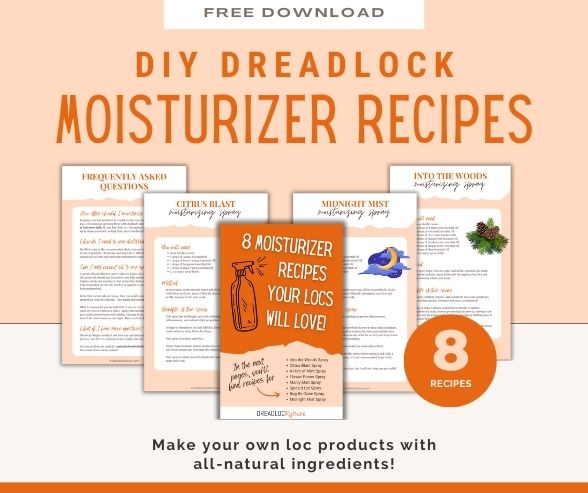
If there’s an error or the download doesn’t come through, send me a message at book@dreadlockulture.com and I will happily send it to you. 🙂


18 comments
This is so helpful, thank you!! Excited to try the recipe. I have a couple questions though, you said to use aloe sparingly because it can loosen new roots. Were you referring to the pure gel straight from the plant? Is the spray ok to use all over scalp more often because it’s diluted? I have a heck of a time trying to get my roots to lock so I definitely don’t want to hinder the process but my head is soooo itchy and flakey as well. Also, can this spray double as a daily moisturizing spray since it has the essential oils in it?
Hi Tess! I’m so happy to hear you’ve found this helpful 🙂
The aloe can loosen the roots a little bit regardless of whether it’s diluted or not.. but if it helps to reduce the itchiness, I would use it as needed. Depending on your hair type, the roots may have a harder time to knot but in due time they will, so don’t worry about that 😉
Yea, it can be used as a moisturizing spray too, but again, it might soften your locs. I’d recommend waiting until they’re a bit more mature (at least 6 months old) and then trying it out to see how your locs adapt to it. <-- That's what I would do, but if you want to try it sooner, it's no problem. The worst that could happen is that they take longer to mature, but it won't damage the locs themselves.
Hi Nadia,
I am about a year.5 into my second set of dreads. I cut my first set off 11 years ago (when my son was 6 months old) and I had had those locks for almost 8 years.
I am looking forward to trying your aloe spray as I have dandruff like crazy…I’ve never had an issue with this, and don’t recall it with my previous set…
So there’s that-And then this is my more pressing issue; I will be hiking the 100 mile wilderness in maine the end of this June, and seem to be having difficulty finding good resources to keep my dreads dry during this hike.
My friend and I plan to take it leisurely and will probably be out there for about 12 days total. I feel somewhat silly asking this question-like the answer should be obvious…but because my locs make my head larger, traditional hats, rain jacket hoods, etc. do not cover my head enough, and I am concerned about my hair getting wet and not drying out, and having to sleep with wet dreads.
If you have any pointers on this, or know if any good resources I would be most appreciative!
I really enjoy the knowledge and information that you share.
Thanks!
-Kristina
Hi Kristina!
That’s amazing! Congrats on your first and second sets of locs 🙂 I would love to hear more about your loc journeys!
The 100-mile hike sounds incredible. Have you tried a bandana made of moisture-wicking materials? Moisture-wicking fabrics are fabrics with the ability to pull moisture away from the skin. Moisture is drawn to the exterior of the fabric, which makes it easier to evaporate. If I were you, I would wrap my locs in that. I use a moisture-wicking bandana when I hike and it helps a lot- plus it keeps the hair out of my face 😉
To keep your scalp fresh, you could take a travel-sized spray bottle with witch hazel and lightly spritz your scalp every other day.
I hope that helps! Let me know if you have any other questions Always happy to help!
-Nadia
I absolutely love aloe vera. My locks are one year 3 months old now and in the beginning I struggled with dry dreadlocks ect. I read up about aloe vera and my luck there is this huge bush of wild aloe vera growing in this park. So I took a few cuttings from them and I planted 6 small branches. They are all getting so big now and new baby ones are growing aswell. So I use that with my blender and rain water rosemary, tea tree and jojoba oil. I use it as a daily spritzer spray. I have another bottle of just rain water and essential oils if I want to take a break in-between. I believe giving your locks moisture every day helps with dry locks. But yeah I agree and love your post. Any more tips for my dread journey. Oh yes I started this new thing and it’s also helping for dry dreads and it seems to be making my locks grow faster. It’s fermented long grain white rice. You first rinse the rice and then you add water (I use rain water) and rub it between your fingers. After a while seel the lid and let it ferment for about 2 days. I add peel of grape fruit or lemon with the fermenting process and the smell is fruity. I add a few essential drops and I strain through cheese cloth and put in spritzer bottle in fridge for one week then make new. I use it about 3 to 4 times a week leaving it in until next wash and that is once a week. Like I said I recently started doing this and all good so far My locks so soft. Just careful for any build up so use a clarifying shampoo every now and again. Blessings to all and especially to you xxx
Hi Tanya!! Thank you for your kind message and for those helpful tips!! 🙂 Wishing you the best on your loc journey!
Hello, I just started my lOc journey, it’s been 3months so far and honestly I’ve been misinformed. And now my dreads are dry and frizzy no matter what I use and they are thinning as well. Do you have any ideas of natural products I could use as a remedy.
Hi Emma! Frizzy hair is completely normal, especially during the early stages of locs, but thinning and dryness is not. Check out this article for DIY moisturizer recipes: https://dreadlockulture.com/dread-moisturizer/
I recommend spritzing your locs once in the morning and sometime in the afternoon/ evening. A light misting is enough whenever you feel they’re dry- don’t overdo it though, you won’t want them soaking wet.
I hope this helps! Happy to help if you have any more questions 🙂
Hi Nadia!
I’m pretty stoked that I came across your blog. I’m 2 months in my dreadlocks journey I’ve been going crazy the past few weeks of fighting my itchy scalp :(. I’m about to try out your aloe spray and was wondering if you had any recommendations for a travel size one where it doesn’t have to be refrigerated?
Hi Don!
Thanks so much 🙂
As for travel options, I would look into dehydrated aloe vera gel- it comes in powder form and you can reconstitute it with water in small quantities. That way, you won’t need to refrigerate it. I will be trying this for myself soon and can let you know the results.
Hellow! I just started my locs journey, thanks for rhis advice. I use Stlyin’ Dredz Products(Spray Shampoo, Mouisture Splash, Mouldin’ Gel Wax) Since I started locking, I’ve experienced a very itchy skin on face, neck and around my chest, on scalp as well. Do you have any idea about these company’s products!? Cause I am tired of using anti allergic pills.Thanks.
Hi Magdalena! Congrats on starting your loc journey 🙂
I haven’t heard of that brand before so I don’t know anything about their products. But if I were you, I would stop using them for at least two weeks to see if your skin condition improves. Meanwhile, look at the ingredients list on the label of each product to identify any ingredients that may be causing the itchiness/ allergies. I would also stop using the gel/wax altogether since that will not benefit your locs- it’ll make them heavy, sticky, and contribute to attracting lint.
If you want to email me photos of the product labels, I can help you determine the good/bad ingredients. Also, I would be happy to provide alternative options for washing and moisturizing your locs using ingredients that will help to improve your skin’s condition and reduce itchiness 🙂 Feel free to get in touch with me directly at nadia@dreadlockulture.com
Best,
Nadia
I appreciate your knowledge on caring for locs. I’m interested in creating my own loc cream/gel to retouch and maintain my locs but need something all natural that will provide a strong hold,thicken, strengthen, grow and protect my scalp from irritation and breakage as well as thinning out without a flaky buildup that smells really nice. Can u help me?
Hi Monique, I’m sorry for the late reply.
I don’t have much experience with creating my own dreadlock products, other than a basic moisturizing spray. As for gel, I use pure aloe vera (from the leaf) but that doesn’t provide too much of a hold, it’s more for itchiness relief. I’ve had a really good experience using Lion Locs Moisturizer Gel (you can read my review here: https://dreadlockulture.com/lion-locs-locking-moisturizer-review/) but if you want to make your own, I would look at the ingredients of that moisturizer, as well as similar brands that have good reviews, and recreate your own version using all-natural ingredients.
I hope that helps! Let me know if you have any other questions. 🙂
Hey I’m Tanya. My dreads are about 2 years and 6 months old. The stages my hair went through was at times very annoying. They would be fizzy or dry ect. I heard about aloe vera and by this one building by the park I took a couple of leaves with the roots and planted it. I have about 7 huge aloe plants now. When needed I cut about 5 leaves (leaves not to big) and I first soak them for 30 min in rain water to get rid of the poison. I discard the water and rinse again just a short while. I take the middel out with a spoon and add some rain water with tea tree oil fresh made lavender water rosemary essential oil a few drops ànd some jojoba oil. Blend it and strain through a stocking. In my spray bottle and I use it basically daily, I’ll skip a day or 2 in-between. Makes my dreads soft and helped with maturing it faster. I also use rice water and coconut milk made from water and coconut flakes or flour and steep for a day and strain through stocking and squeeze it till all milk is all out. Keep in fridge all your home made products. I take rice water and coconut milk and keep it in my dreads at least an hour then rinse and shampoo sulphate free. Thanks for your article
Hi Tanya! Wow, your hair products and loc care routine sound amazing. I would love to try rain water on my locs sometime!! It doesn’t rain enough where I live but I’m sure it leaves the hair in much better condition than water from the tap.
Thanks so much for sharing!! 🙂
Hi when I spray this blend? Is it after shampooing? Thanks
Hi! You can spray it anytime. 🙂 I spray it when my scalp gets itchy, which is usually when my hair and scalp is dry.