
If you’re thinking about starting your loc journey, one of the first questions you might ask is: Which hair type locks the fastest?
While every hair journey is unique, the texture and type of your hair play a major role in how quickly your locs will mature.
In this guide, we’ll break down the different hair types, how they influence locking speed, and what you can do to encourage healthy, fast-forming locs.
Understanding hair types and loc formation
Before we dive into which hair type locks up the fastest, it’s important to understand the unique characteristics of each of the four hair types.
Type 1 – Straight Hair
- Texture: Smooth and silky
- Porosity: Low (oils travel easily down the hair shaft)
- Locking ability: Slips easily, tangles less
- Time to mature locs: 24–36 months
Type 1 hair is naturally resistant to knotting due to its smooth structure and lack of texture. This makes locking more of a challenge, and people with straight hair typically need more time and/or maintenance to achieve mature locs.
Type 2 – Wavy Hair
- Texture: Loose “S” shaped waves
- Porosity: Low to medium
- Locking ability: Moderate
- Time to mature locs: 12–36 months
Wavy hair holds a bit more grip than straight hair, making it slightly easier to form locs. However, the wave pattern still allows for some slippage, meaning locking can still take time.
Type 3 – Curly Hair
- Texture: Spiral curls and ringlets
- Porosity: Moderate
- Locking ability: Good
- Time to mature locs: 12–36 months
Curly hair has a natural tendency to tangle and knot, which aids in the locking process. Because of this texture, type 3 hair forms locs faster than straight or wavy hair.
Type 4 – Coily/ Kinky Hair
- Texture: Tight “S” or “Z” shaped coils
- Porosity: High
- Locking ability: Excellent
- Time to mature locs: 6–12 months (although in some cases up to 24 months)
Type 4 hair locks up the fastest due to its dense structure, high surface tension, and natural volume. The tight coils encourage matting and tangling, which are essential for loc formation.
How to encourage your locs to mature faster
No matter your hair type, there are things you can do to speed up the locking process while maintaining healthy hair. Here are some expert-recommended tips:
1. Choose the right loc starting method
There are several methods to start your locs, but different hair types respond better to different techniques. For instance:
- Twist and Rip – Ideal for straight hair
- Backcombing – Often used on straighter textures
- Crochet Method – Works on all hair types
- Two-Strand Twists or Coils – Great for curly and coily hair
Choosing the right method from the start can influence how quickly your locs begin to form and mature.
2. Wash your hair weekly
You should wash your locs regularly, ideally once a week. Clean hair tangles and knots better than oily or dirty hair. Think of it like spaghetti: without oil, it sticks together easily. Add oil or butter, and it slides apart.
Washing your hair keeps it free of residue and buildup, which allows the strands to knot and lock faster. Just make sure to use a residue-free shampoo that won’t coat the hair shaft.
3. Avoid waxes and butters
While it may be tempting to use products like beeswax or shea butter to “help” your locs, these can actually slow down the locking process. They coat the hair, making it harder for strands to knot together, and they’re extremely difficult (if not impossible) to wash out later.
Here’s a list of all the things you should never put in your locs.
Stick to light, water-based moisturizers or natural oils that won’t leave behind heavy residue.
4. Moisturize daily
Healthy hair locks faster, and that starts with hydration. Use a simple water-based spritz to moisturize your locs every morning. This keeps your hair flexible, reduces breakage, and promotes overall hair health as your locs mature.
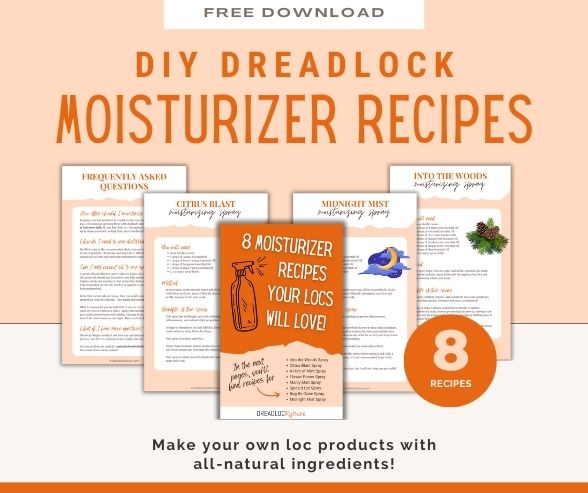
Click here to download my free e-Book with 8 DIY moisturizer recipes!
5. Palm rolling
Palm rolling is a technique that helps locs take on a more uniform, cylindrical shape. Simply roll each loc between your palms from root to tip, especially after washing, while your hair is still damp. This also helps prevent lumps and encourages even knotting.
Final thoughts
When it comes to locking speed, type 4 hair comes out on top, thanks to its tightly coiled structure, high porosity, and density.
But remember: no matter your hair type, your loc journey is personal, and with the right care and techniques, anyone can achieve strong, mature, and beautiful locs.
If you’re just starting out, be patient and consistent. Choose a method that works for your hair type, keep your scalp and hair clean, avoid heavy products, and stay hydrated. Over time, your hair will lock up beautifully.
Download the 8 Dreadlock Moisturizer Spray Recipes!
Please fill out the form to receive the download in your inbox.
If there’s an error or the download doesn’t come through, send me a message at book@dreadlockulture.com and I will happily send it to you. 🙂


