

Freeforming is one of the most natural ways to begin the loc journey because, instead of creating a specific shape and repeatedly maintaining it, you allow your hair to tangle, mat, and eventually form locs with very little manipulation.
But “freeform” does not mean you stop caring for your hair altogether.
So what exactly are freeform locs, and could this be the right way for you to start your loc journey?
What Are Freeform Locs?
Freeform locs are locs that have been allowed to form naturally, or with minimal manipulation. Rather than creating precise sections with comb coils, two-strand twists, crochet, or another starter method, the hair is left to tangle over time all on its own.
As the hair naturally forms knots, it gradually becomes more compact and develops into locs.
With traditional starter loc methods, someone intentionally creates the initial sections which ultimately determine the shape and thickness of each loc. With freeforming, you give your hair much more freedom to determine where those sections develop and how large or irregular the locs become.
That means you will likely end up with locs of different sizes and shapes.
There is no universal rule that defines exactly how much manipulation disqualifies a set of locs from being freeform. The general idea is that this method requires minimal interference and, for the most part, the hair is left to develop locs naturally.
Can Freeform Locs Be Used as a Starter Method?
Yes. If you’re starting from loose natural hair, you can allow your hair to begin forming locs on its own instead of using any of the common starter methods.
You literally stop detangling your hair and allow it to naturally tangle and form. As your hair grows, sheds, knots, and becomes more compact, individual locs gradually begin to emerge.
On the other hand, when you choose a structured starter technique, you have more control over your parting, loc size, and overall appearance. With freeforming, you give up much, if not all, of that control.
If you already know that you want uniform locs with consistent parts, freeforming may frustrate you. If you’re comfortable allowing your hair to do its thing and surprise you, it might be the perfect starting method for you.
How to Start Freeform Locs
Starting freeform locs is relatively simple, but “simple” doesn’t mean careless. These are a few steps to follow:
1. Start with clean hair
Begin with a clean scalp and clean hair. You want to start your loc journey without unnecessary product buildup sitting on the hair.
A loc-friendly, residue-free shampoo is enough. But if you want your hair to be extra clean, wash it with a clarifying shampoo before starting.
Do not use wax, heavy gels, or thick creams to force your hair to lock. Those products will leave buildup and are more damaging than beneficial.
You should also stop using conditioner, since it is counterproductive to the locking process.
2. Stop detangling
Next, allow the natural tangling process to begin. Really soon, your hair will start creating significant knots, which will eventually turn into locs.
3. Let your hair decide the sections
One of the defining characteristics of freeform locs is that you don’t have complete control over where one loc ends and another begins.
Your hair may naturally create smaller locs in one area and larger ones somewhere else. If you want to have minimal control over your loc sections, you can guide them by separating the roots in some areas.
4. Be patient
Freeform locs don’t come with a predictable timetable. The amount of time it takes for hair to develop recognizable locs depends on factors including hair texture, density, curl pattern, and the method used to start them.
Because freeform locs are started from scratch, they can take a few months to a year longer than any of the other techniques. Regardless, they will become mature locs eventually.
Here, you can learn more about the time it takes locs to become mature and which hair types mature the fastest.
Do Freeform Locs Need Maintenance?
Yes, but the maintenance looks different than all other loc techniques.
All locs, regardless of the way they were started, need to be clean.
Your scalp produces oil, your hair collects sweat and environmental debris, and your locs can accumulate residue if they’re not properly cleansed. Regular washing is an important part of maintaining a healthy scalp and hair.
After washing, allow your locs to dry completely. This is particularly important because thick locs can hold moisture for a long time. Leaving locs damp for longer than 23 consecutive hours can increase the chances of mold growth.
You should also pay attention to how your roots are developing. If several locs are joining together and you don’t want them to permanently combine, you may choose to gently separate them. This moves you toward semi-freeforming, because you’re beginning to intentionally influence the structure of your locs, but that’s not a bad thing.
Freeform vs. Semi-Freeform Locs
Generally, freeform locs involve allowing the hair to form with little to no intentional shaping, while semi-freeform locs involve some intentional maintenance while still allowing the locs to remain relatively natural and unstructured.
For example, someone with semi-freeform locs might:
- Wash regularly
- Separate locs at the roots
- Occasionally tidy loose hairs
- Occasionally palm roll or manipulate certain areas
- Avoid regular retwisting
- Allow the locs to retain their natural irregular shapes
Someone else might use the term semi-freeform simply because they started their locs with a method such as comb coils, twists, or the crochet method, and later stopped regular maintenance.
This is why you’ll see different definitions online. There is nothing that specifically defines whether someone’s locs are “officially” freeform. The term describes a spectrum of how much control and manipulation a person chooses to use.
How Long Do Freeform Locs Take to Form?
There is no reliable universal timeline.
Some people begin seeing obvious loc formation within months, while others may spend much longer in the tangled or budding stages. Hair texture is one of the major factors, but it isn’t the only one.
Length, density, curl pattern, washing habits, and how much the hair is manipulated can all influence the process.
And “forming” is different from “mature.”
You might see recognizable locs relatively early while the inside of those locs is still loose and developing. Locs continue changing as the hair becomes more compact and established.
That’s why it makes more sense to think of freeforming as a process rather than a deadline.
What Are the Pros and Cons of Freeform Locs?
Benefits
The biggest advantage of freeform locs is the freedom it gives you.
You aren’t committing yourself to a strict retwist schedule or trying to make every loc look neat and uniform. You also get to see your hair develop a pattern that isn’t completely predetermined.
Another benefit is that all hair types will knot, so freeform locs can be worn by anyone regardless of their hair texture, thickness, and density.
Disadvantages
The downside is the lack of control.
Your parts will very likely not be symmetrical. Some locs may become much thicker than others. And once formed, your locs may merge if you don’t intervene, so your finished set may look very different from what you started with.
Freeforming also requires a lot of patience. Since you’re not starting out with pre-made locs (crocheted/instant locs, two-strand twists, interlocked, etc), you’ll have to wait the additional time it takes for your hair to form its own knots.
Who Is Freeform Locs Best For?
Freeforming may be a good choice if you:
- Want a low-manipulation loc journey
- Don’t want perfectly uniform parts
- Are comfortable with frizz and irregular shapes
- Want your locs to develop organically
- Don’t want frequent retwisting
- Are willing to be patient with the process
- Like the idea of discovering what your natural hair will do
Frequently Asked Questions
Is Freeforming the Same as Neglecting Your Hair?
No. Freeform locs are about reducing manipulation, not eliminating hair care.
You can have freeform locs and still have a consistent wash routine. You can keep your scalp clean. You can pay attention to thinning areas. You can moisturize when your hair needs it. You can protect your locs while sleeping and make sure they’re thoroughly dry after washing.
What you’re choosing to leave alone is primarily the formation and shape of the locs, not your scalp and hair hygiene.
Freeform locs are not, as many stereotypes would have you believe, a modern “lazy hairstyle” for hippies.
Can Any Hair Type Have Freeform Locs?
All hair types can form locs with the freeform method; however, each loc set can look vastly different.
Curly and tightly coiled hair naturally has more bends and curves that allow strands to knot faster.
Due to the nature of straighter and loosely wavy hair, it may take much longer for those hair types to tangle and compact into a stable loc structure.
Can You Start Freeform Locs With Short Hair?
You don’t need long hair to begin a freeform journey. However, extremely short hair may not have enough length to visibly tangle and establish recognizable locs right away.
Can You Wash Freeform Locs?
Absolutely. You should not avoid washing your hair simply because you’re freeforming.
In fact, keeping the scalp and locs clean is an important part of healthy loc care. Contrary to the many myths and stereotypes about locs, hair actually knots best when it’s clean. You should wash your hair once every 5 to 10 days.
After washing, make sure your locs dry thoroughly so moisture isn’t trapped inside dense sections of hair.
Do freeform locs need to be retwisted?
No. Regular retwisting isn’t a requirement for freeform locs. In fact, frequent root manipulation would move the process away from true freeforming. You can still choose to tidy or separate areas when necessary, but that becomes more of a semi-freeform approach.
Can freeform locs merge?
Yes. Because you’re allowing your hair to determine its own sections, neighboring locs can begin to join together. If you want to prevent this, you may need to separate them periodically.
Are freeform locs healthier than traditional locs?
Not necessarily. Freeforming reduces manipulation, but hair health still depends on things such as scalp hygiene, weekly washing, gentle handling, adequate moisture, and avoiding excessive tension.
Can you turn starter locs into freeform locs?
Yes. You can stop regular retwisting and allow your existing locs to grow out and develop more naturally. Because your locs already have established sections, this is often described as semi-freeforming rather than starting with completely organic freeform locs.
Do you need products to start freeform locs?
No. Products aren’t what makes freeform locs form. The process relies primarily on allowing the hair to naturally tangle and form locs. Using residue-free products is critical for preventing buildup accumulation in locs. Water-based products are the best; however, if you want to use oils for moisture retention, use lightweight oils and mostly on your scalp, not so much along the locs themselves.
Are freeform locs permanent?
Freeform locs can be permanent if you want them forever, but they don’t have to be. Locs can be combed out, but the difficulty depends on how mature, compact, and established they are. The more mature the locs become, the more time it generally takes to separate the matted hair. Freeforming should therefore still be viewed as a significant hair commitment.
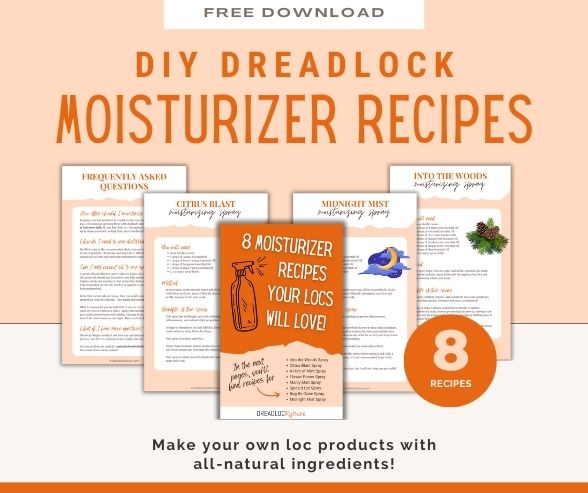
Download the 8 Dreadlock Moisturizer Spray Recipes!
Please fill out the form to receive the download in your inbox.
If there’s an error or the download doesn’t come through, send me a message at book@dreadlockulture.com and I will happily send it to you. 🙂