
When starting locs, one of the biggest questions is: How do I make sure they turn out the thickness I want? Some people prefer small, delicate locs while others love a fuller, chunkier look.
The outcome depends on several key factors, and once you understand them, you can better predict your loc journey.
What determines loc thickness?
Sectioning
Sectioning is the foundation for loc thickness. The size of the scalp parts created at the beginning determines how big or small your locs will be once mature.
- Larger sections = thicker locs
- Smaller sections = thinner locs
If a loctician started your locs, the parting pattern they created will already give you a clear idea of your future loc size.
Hair Density
Your natural hair density also plays a major role. Density refers to the number of follicles in a specific area of your scalp.
- Low-density hair usually leads to thinner locs.
- High-density hair usually produces thicker locs.
There are two ways to check:
The Ponytail Method (if you don’t yet have locs):
- Gather all your hair into a ponytail.
- Measure the circumference with a tape measure.
- Less than 2 inches = low density
- 2–3 inches = medium density
- More than 3 inches = high density
The Scalp Test (if you already have locs):
Look at how visible your scalp is when your hair isn’t freshly parted. If your scalp shows easily, you likely have low density. If it’s harder to see, your density is higher.
Strand Thickness
The thickness of each strand also contributes.
Compare a strand to sewing thread:
- Thinner than a thread = fine hair
- About the same = medium hair
- Thicker than a thread = coarse hair
Feel the difference by touch:
Fine strands are barely noticeable between your fingers, while coarse strands feel strong and obvious.
Do Locs Get Thicker or Thinner Over Time?
Even with all these factors in place, your locs will still change as they mature. In the early stages, the thickness is unpredictable.
You may notice some areas puffing up, while others look thinner. Certain sections may loosen while others tighten. Loops often form, and each loc seems to have a personality of its own. This stage is temporary.
Once your locs fully mature, the size usually stabilizes.
Adjusting Loc Thickness
If Your Locs Feel Too Thick
- The most reliable option is to brush out the loc, re-section the root, and start again.
- Cutting a loc down the middle is not recommended. Because locs are made of intertwined strands, slicing through them can weaken the structure, leading to long-term thinning or breakage.
If Your Locs Feel Too Thin
- Two locs can be combined with a crochet hook by an experienced loctician.
- You can also let them naturally combine, known as a “congo,” where two locs begin to fuse at the root.
Risks of Very Thick Locs
While thick locs are beautiful, they do come with specific challenges:
- Mildew: The thicker the loc, the longer it takes to dry. Even medium-thick locs may take 8+ hours. In colder months, wash in the morning and use a blow dryer on low to avoid mildew.
- Weight and Root Thinning: Thick locs become heavy as they grow, which can pull on roots and cause thinning, especially if you have low-density hair.
- Neck and Shoulder Strain: Very heavy locs can put pressure on the neck and shoulders, which may add to existing tension or headaches.
Achieving your desired loc thickness starts with understanding three things: sectioning, hair density, and strand thickness. While your locs will naturally change as they mature, knowing these factors can help you set realistic expectations.
If you ever feel your locs are too thick or too thin, adjustments are possible. The key is making informed choices early on and being patient as your hair develops its final look.
Download the 8 Dreadlock Moisturizer Spray Recipes!
Please fill out the form to receive the download in your inbox.
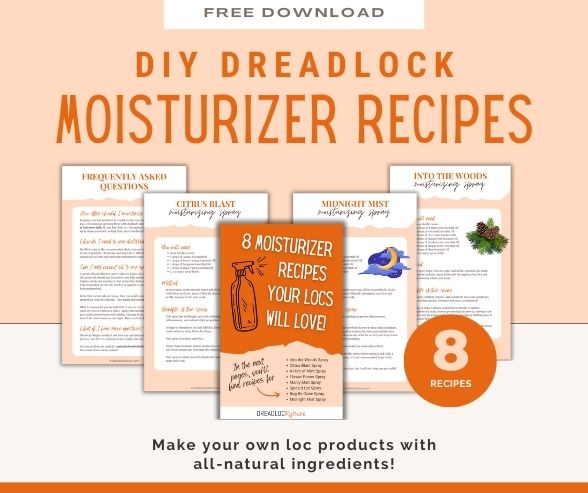
If there’s an error or the download doesn’t come through, send me a message at book@dreadlockulture.com and I will happily send it to you. 🙂