
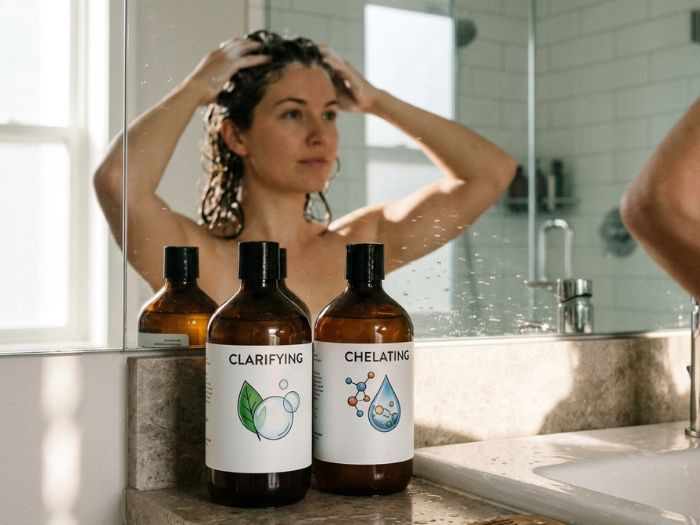
If you’ve been trying to remove buildup from your locs, you’ve probably come across two terms: clarifying shampoo and chelating shampoo.
They’re often used interchangeably, but they aren’t the same.
Both can help remove unwanted residue from your hair, but they work differently and are better suited to different types of buildup.
Clarifying shampoos are primarily designed to remove excess oils, styling products, dirt, and other residue. Chelating shampoos contain ingredients that bind to metal ions, making them particularly useful for removing mineral deposits associated with hard water.
In this article, I will break down the difference so you can choose the appropriate type of cleansing treatment for your locs.
What Does Clarifying Shampoo Do?
A clarifying shampoo is a stronger cleansing shampoo designed to remove excess residue from the hair and scalp.
That can include:
- Excess oils
- Styling products
- Sweat
- Dirt
- Environmental residue
- Other product residue
The main cleaning ingredients come from surfactants, which are cleansing ingredients that help water lift away substances such as oils and other materials that don’t readily mix with water.
Think about washing an oily dish. Water alone doesn’t do a very good job of removing grease because oil and water don’t mix. A cleanser helps loosen and suspend that oily material so it can be rinsed away. Shampoo works similarly.
Why Might Locs Need Clarifying?
Locs can be especially prone to holding onto residue because their structure is different from loose hair. Some products are especially difficult to wash off, while residue-free products might still leave residue if they’re not rinsed out properly.
If residue accumulates, your locs will feel:
- Heavy
- Coated
- Sticky or greasy
- Dull
- Less flexible
If you use lightweight products sparingly and wash your locs regularly with a loc-friendly shampoo, you may only need to clarify your locs once every few months. If you want to clarify them on a regular basis, I would recommend washing with regular shampoo for 5 consecutive weeks (once a week) and using a clarifying shampoo on the 6th week.
This will prevent your hair from drying out too much.
Does Clarifying Shampoo Remove Hard Water Buildup?
Hard water contains dissolved minerals, particularly calcium and magnesium. Research has found that repeated exposure to hard water can increase mineral deposition on the hair shaft, although the evidence about how much this changes the actual structure and strength of hair is mixed.
A regular clarifying shampoo may help clean away some residue associated with washing, but a shampoo is not automatically capable of removing mineral deposits simply because it is labeled “clarifying.”
Some clarifying shampoos contain chelating ingredients. Others don’t.
That’s why you need to read the ingredients on the label. If hard water is the suspected source of buildup, look for a shampoo specifically formulated for hard water or one that contains recognized chelating ingredients.
What Does Chelating Shampoo Do?
A chelating shampoo is formulated with ingredients that can bind to metal ions and help remove them during rinsing.
Hard water commonly contains calcium and magnesium ions. Certain chelating agents can bind these metal ions, forming complexes that are easier to remove during washing. The process is called chelation.
Common Chelating Ingredients to Look For
If you’re looking for a chelating shampoo for hard water buildup, don’t rely solely on the words “clarifying” or “chelating” on the front of the bottle.
Check the ingredient list.
Some ingredients you may encounter include:
EDTA
EDTA, or ethylenediaminetetraacetic acid, is a well-known chelating agent that can bind metal ions.
Disodium EDTA
Disodium EDTA is a salt form of EDTA used in cosmetic formulations.
Tetrasodium EDTA
Tetrasodium EDTA is another EDTA salt used in personal-care products.
Phytic Acid
Phytic acid is a naturally occurring compound found in many plants, particularly seeds and grains.
Citric Acid
Citric acid can interact with metal ions and is also widely used to adjust the pH of cosmetic formulations. However, seeing citric acid on a shampoo’s ingredient list does not automatically mean that the product is a powerful hard-water treatment.
The effectiveness of a formula depends on the ingredient combination, concentration, pH, formulation, and how the product is used.
| Clarifying Shampoo | Chelating Shampoo | |
|---|---|---|
| Main purpose: | Removes excess residue | Helps remove mineral deposits |
| Best for: | Oils, butters, styling products, dirt, and residue | Hard water minerals and metal deposits |
| Uses surfactants? | Yes | Yes |
| Uses chelating agents? | Sometimes | Yes |
How Do You Know Which One Your Locs Need?
To determine which treatment your locs need, you need to get to the source of the buildup.
Choose a clarifying shampoo when your locs feel coated, greasy, heavy, or unusually stiff and you suspect product buildup. One way to check is to gently bend your locs in several places and examine the areas where the loc naturally opens or separates slightly. Look for visible residue such as a waxy or greasy film, creamy deposits, lint, dust, or other material trapped within the loc. If you can see product residue inside the loc rather than simply on its surface, it may be a sign that a deeper cleansing treatment is needed.
Consider a chelating shampoo if you think hard water may be causing the buildup. Hard water buildup can make your locs feel dull, coated, or stiff, so it can be easy to mistake it for product buildup. The way to distinguish between the two is that with product buildup, you will see residue trapped within the loc. On the other hand, with mineral buildup, you won’t see any product stuck in the locs.
Another distinguishing clue is your shower. Take a look at your faucet, shower head, shower walls, and other surfaces that regularly get wet. If you notice a white, cloudy, chalky, or crusty coating building up on these surfaces, your water may be high in minerals.
Finally, you can test your water’s hardness. Home water hardness test kits are an easy way to check whether your water contains elevated levels of minerals.
Click here to learn more about hard water.
What If You Have Both Product and Mineral Buildup?
It is possible to have both product buildup and mineral buildup at the same time.
For example, imagine that you wash your locs with hard water. Then apply oils or other moisturizing products. If you continue this routine for months, you will gradually accumulate both product residue and mineral deposits.
In this situation, using only a product-focused cleanser may not address the mineral component. Likewise, choosing a chelating treatment doesn’t mean you’ve eliminated every type of product residue.
Do You Need to Clarify Before Chelating?
If your locs have significant product buildup, removing excess residue first may help a chelating treatment work more effectively by allowing the formulation better access to the hair surface.
But you don’t need to automatically use two shampoos every time you suspect hard water.
Start with the treatment that matches the most likely source of the buildup.
If you’re dealing primarily with heavy product residue, start with a clarifying shampoo or a loc detox and see how your locs feel afterwards.
If you’re dealing primarily with hard water, a properly formulated chelating shampoo may be enough.
How Often Should You Clarify or Chelate Locs?
There isn’t a scientifically established schedule that applies to everyone.
Your ideal frequency depends on factors such as:
- How often you wash your locs
- How much product you use
- The type of products you use
- Your household water hardness
- How your locs respond to cleansing
- Your scalp and hair needs
The best protocol is to use these treatments when there is a reason to use them.
Over-cleansing can leave hair feeling dry or rough, particularly if your routine involves strong cleansing products and your hair doesn’t need that level of cleansing. At the same time, avoiding deeper cleansing indefinitely isn’t necessarily better.
To prevent drying out and damaging your hair, I recommend using clarifying shampoos no more than once every 6 weeks, and chelating shampoos no more than once every 3 months.
Should You Moisturize After Clarifying or Chelating?
If your locs feel dry after a deeper cleansing treatment, follow with a lightweight moisturizing routine. You can either use a water-based moisturizer like this one or a rose water moisturizer like this one.
Frequently Asked Questions
Is chelating shampoo better than clarifying shampoo for locs?
Neither is automatically better. Clarifying shampoo is primarily intended to remove accumulated residue such as oils, shampoo residue, and buildup from other products, while chelating shampoo is particularly useful for mineral deposits from hard water. Choose based on the source of the buildup.
Can clarifying shampoo remove hard water buildup?
Sometimes, but it depends on the formula. Some clarifying shampoos contain chelating ingredients and can therefore help with mineral deposits. Others are primarily formulated to remove oils and product residue. Be sure to check the ingredient list.
Does chelating shampoo remove product buildup?
It can provide cleansing because chelating shampoos also contain surfactants, but a product specifically formulated for heavy product buildup may be more appropriate if oils or other product buildup is your primary concern.
How do I know if my locs have hard water buildup?
Hard water buildup may leave hair feeling coated, stiff, dull, or difficult to rinse clean. However, these signs can also occur with product buildup and other issues. If there are mineral deposits found in your bathroom walls, sink, faucets, etc, that is a strong clue that you have hard water. The best method, however, is to test your household water hardness. This can provide stronger evidence that hard water is contributing to the problem.
Does chelating shampoo damage locs?
Chelating itself isn’t a reason to assume a shampoo will damage your locs. The overall formulation, cleansing strength, frequency of use, and your hair’s condition all matter. Follow the product directions, don’t wash too often with these types of shampoos, and avoid unnecessary over-cleansing.
Is apple cider vinegar a chelating treatment?
Apple cider vinegar is acidic and may help alter the pH and loosen or dissolve some mineral deposits, but an ACV rinse should not automatically be considered equivalent to a professionally formulated chelating shampoo. The strength and chemistry of a formulated chelating product are different. This is especially important when you’re dealing with significant hard water buildup.
Download the 8 Dreadlock Moisturizer Spray Recipes!
Please fill out the form to receive the download in your inbox.

If there’s an error or the download doesn’t come through, send me a message at book@dreadlockulture.com and I will happily send it to you. 🙂


